

Accrual accounting in healthcare is not a compliance checkbox or an accounting preference. It is the difference between knowing what your practice is actually doing financially and making decisions based on a number that has almost nothing to do with your real performance. If your books are on cash basis, your monthly financials are telling you when money moved through your bank account. They are not telling you when your practice earned it. For a healthcare business where claims are submitted, adjudicated by payers, and collected weeks or months after the service was delivered, that distinction is enormous.
Cash basis accounting is not a small-practice problem or a transitional phase. It is a problem from day one. It just gets harder to ignore as the practice grows.
What You’ll Learn
• Why cash basis accounting produces an unreliable financial picture as a practice grows beyond one location
• What accrual accounting actually changes about the monthly numbers a practice owner or administrator sees
• The specific signals that tell you a practice has outgrown its current accounting method
• How the switch from cash to accrual works in practice, and why it is less disruptive than most owners expect
• What becomes possible, financially, once your practice is on accrual accounting and producing accurate, comparable monthly reports
Table of Contents
1. The Real Problem with Cash Basis Accounting in Healthcare
2. What Cash Basis Is Hiding From You Right Now
3. How Does Accrual Accounting Work in a Healthcare Practice?
4. What Changes the Day You Switch to Accrual
5. When Should a Healthcare Practice Switch from Cash to Accrual?
6. What the Switch Actually Looks Like in Practice
7. Questions Practice Owners Ask Before Switching Accounting Methods
8. Honest Numbers Are Not Complicated. They Are Just Accurate.
The Real Problem with Cash Basis Accounting in Healthcare
Here is the core issue with cash basis accounting for a medical practice: it records revenue when payment arrives and expenses when they are paid. On the surface, that sounds sensible. In practice, it creates a financial picture that is almost entirely disconnected from how your business is actually performing month to month.
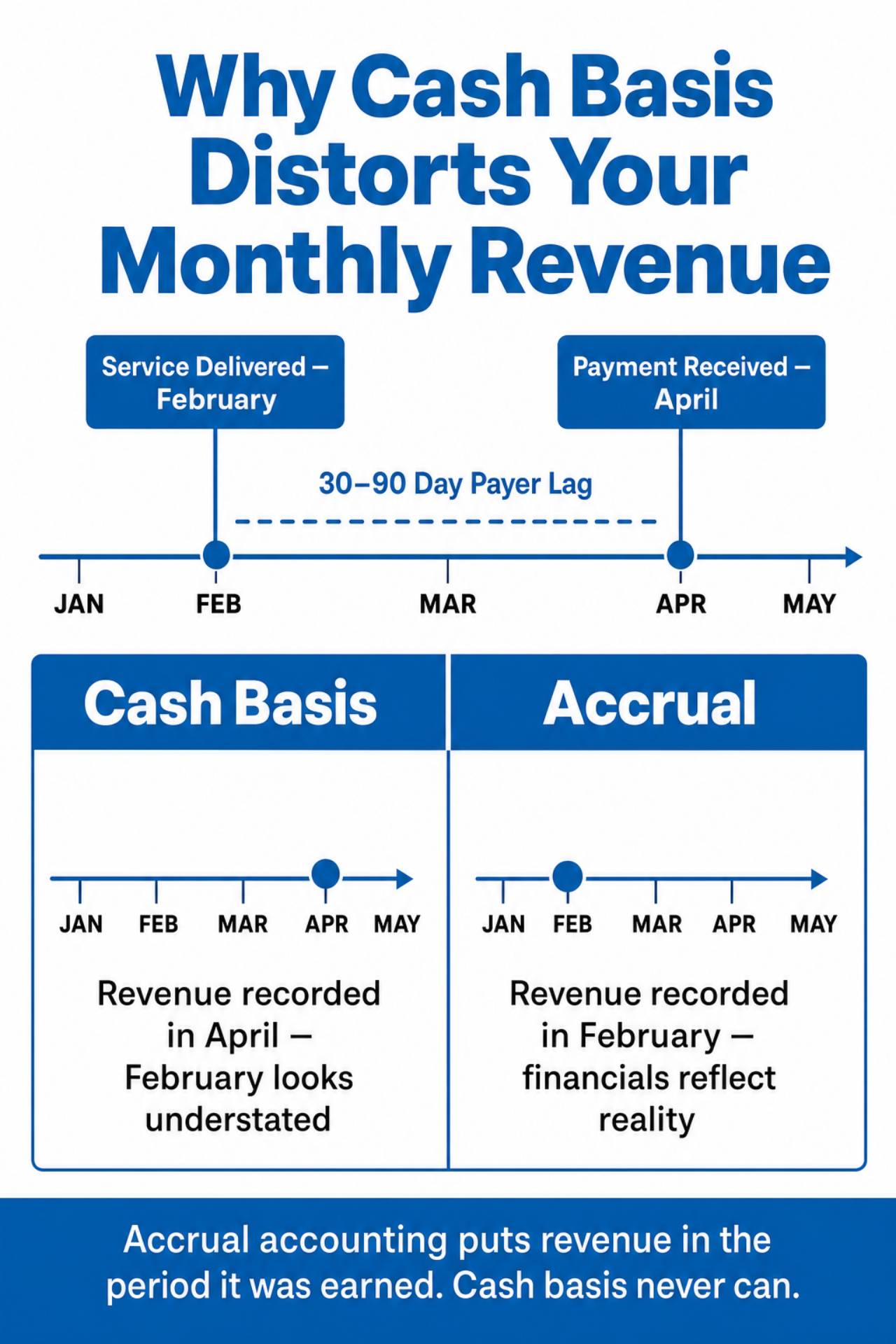
Healthcare revenue does not work like a retail sale. A patient receives care on a Tuesday. A claim goes out to the insurance payer. The payer adjudicates it over the following weeks. Payment arrives, often at an adjusted amount, somewhere between 30 and 90 days later. Under cash basis, none of that revenue appears in your books until the day the payment hits your bank account. The service happened in February. The revenue shows up in April. Your February financials look worse than reality. Your April financials look better than reality. And neither number tells you how February actually performed.
This is not a quirk you can work around. It is a structural flaw in how cash basis accounts for the kind of revenue a healthcare practice generates. And it affects every financial decision you make.
Cash basis accounting records revenue when cash is received, not when services are delivered. For a growing healthcare practice, that timing gap distorts every financial decision.
What Cash Basis Is Hiding From You Right Now
The distortion shows up in several ways that matter practically. If your practice is on cash basis, here is what you likely cannot see clearly:
• Your real monthly EBITDA. When revenue recognition is tied to payment timing rather than service delivery, your EBITDA swings unpredictably from month to month. A large batch of payer payments landing in one period inflates that month. A slow collection period deflates the next. Neither number reflects the underlying performance of the business.
• Your actual burn rate. You need to know how much the practice costs to run every month. On cash basis, that figure fluctuates based on when bills happen to be paid, not when the underlying obligations were incurred. A malpractice premium paid in January is a January expense under cash basis. Under accrual, it is spread across the periods it actually covers.
• Comparable period-over-period trends. If you cannot reliably compare February to March, or this April to last April, you cannot identify whether things are improving, deteriorating, or holding steady. Strategic decisions about staffing, expansion, and distributions require trends. Cash basis does not produce them.
• Per-location profitability across multiple entities. When collections from multiple payers land unpredictably across accounts tied to different locations, location-level P&Ls on a cash basis are close to meaningless.
One of our clients, a single-location practice, had been doing everything on a cash basis and not touching their books for months at a time. They had no idea what their monthly EBITDA was or what their burn rate looked like. They could not make clear decisions about whether they could bring on a new physician or expand services, because the numbers never told a coherent story. After we restated five months of financials on an accrual basis, the answer became simple: their monthly operating expenses were around $200,000. Collect more than $220,000 and the practice is profitable. As Chris Morgan describes it: “Their mind was blown at how simple it had become to understand what was going on in their business.” Nothing changed in the practice. The financials just finally reflected reality.
If your close is also running late on top of operating on cash basis, the cost compounds further. The Month-End Close Cost Calculator shows you what a slow close is actually costing your practice, separate from the accounting method problem.

How Does Accrual Accounting Work in a Healthcare Practice?
Accrual accounting matches revenue to the period in which services were delivered and expenses to the period they relate to, regardless of when cash actually moves.
In practical terms for a healthcare practice, this means:
• Revenue from a patient visit in February is recorded in February, even if the payer does not remit until April
• The malpractice insurance premium paid as a lump sum in January is spread across the months it covers, not dumped entirely into January
• Payroll for the last week of March is a March expense, even if the cheque clears in April
• Contractual adjustments from payer contracts are recognised at the time of service, so revenue is never overstated based on what was billed
The result is a monthly financial picture where revenue and expenses reflect the period they belong to. February looks like February. March looks like March. You can compare them meaningfully, identify trends, and make decisions grounded in what the business is actually doing rather than what happened to land in the bank.
A multi-location medical practice cannot produce reliable per-location profitability reporting on a cash basis. The numbers will always lag, and the trends will never be clear.
This matters most for outsourced accounting for healthcare practices that are navigating complexity across entities, because the accrual foundation is what makes multi-entity consolidation accurate rather than approximate.
What Changes the Day You Switch to Accrual
The shift is not abstract. Here is what becomes visible that was not visible before:
Monthly financials become comparable. When revenue is recognised in the period it was earned, you can line up February against March against February of last year and actually learn something. Spikes and dips reflect real business events, not the timing of payer payments.
EBITDA becomes a reliable operating metric. You can set a monthly target, track against it, and know whether you are above or below based on what the practice actually did, not based on which payments happened to clear.
Burn rate becomes a planning tool. Knowing that your practice costs approximately $200,000 per month to operate, and that this number is consistent and comparable, changes how you plan for distributions, expansion, and hiring. As Chris puts it: “You can’t run a business based on when you pay your bills and when you get paid.”
Growth decisions become grounded. Whether to open a fourth location, bring on an associate, or distribute to partners, these questions require reliable monthly profitability data. Accrual provides it. Cash basis does not.
Audit and transaction readiness improves substantially. If a lender, PE group, or potential acquirer asks to review your financials, books maintained on an accrual basis are far more likely to hold up to scrutiny. Cash basis records require significant restatement work before they are usable in any diligence process.
Switching to a fully outsourced accounting department that handles accrual-basis accounting from month one removes the ongoing burden of maintaining this correctly internally, and ensures that the financial picture you see every month is accurate, comparable, and decision-ready.

When Should a Healthcare Practice Switch from Cash to Accrual?
The answer is: sooner than most practices make the change.
Cash basis is sometimes presented as appropriate for smaller practices and accrual as a concern for larger ones. That framing is misleading. A practice’s need for accurate, comparable financial data does not begin at a particular revenue threshold. It begins the moment the owner or administrator needs to make a consequential financial decision based on that data.
The signals that tell you the switch is overdue include:
• Multiple locations or entities. If you have more than one location operating under separate legal structures, cash basis consolidation is not just imprecise. It is unreliable.
• Insurance payer mix. Any practice billing insurance is dealing with the timing lag between service delivery and payment receipt. The more complex the payer mix, the more distorted cash basis becomes.
• Growth decisions on the table. If you are considering a new location, a new hire, or a distribution, you need reliable monthly EBITDA. Cash basis cannot provide it.
• Lender or investor relationships. Banks, PE groups, and potential acquirers expect accrual-basis financials. If yours are on cash basis, they need to be restated before any diligence process can begin.
• Transaction or audit preparation. Any formal review of your finances will expose cash basis records as inadequate for the level of scrutiny involved.
Many practices across greater Nashville and middle Tennessee, including those in Brentwood, Franklin, and the surrounding communities, are at this inflection point without fully recognising it. The practice looks successful from the outside. Collections are coming in. The team is growing. But the financial infrastructure underneath was designed for a simpler version of the business that no longer exists.
The accounting decisions that shape how a healthcare practice operates long-term start with this one. Getting the foundation right early avoids the far more disruptive work of restating years of records when a transaction, audit, or growth plan makes it unavoidable. For context on the broader accounting decisions that shape how a healthcare practice operates, this question sits at the centre of most of the conversations we have with new clients.
What the Switch Actually Looks Like in Practice
The most common objection we hear is that switching from cash to accrual sounds disruptive. It does not have to be.
The process involves three practical steps:
1. Restate prior periods. Adjusting the historical books to reflect when revenue was earned and when expenses were incurred, rather than when cash moved. For a practice with reasonably complete records, this is a defined project with a clear endpoint.
2. Establish correct accrual entries going forward. Setting up the recurring entries, deferred revenue, accrued expenses, prepaid accounts, that ensure every future period is captured correctly from day one.
3. Standardise the chart of accounts. For multi-entity practices, this is the step that makes consolidated reporting possible. Inconsistent account structures across locations are one of the most common reasons multi-entity consolidations fail.
Done by a team that understands healthcare-specific revenue recognition, this process is well-defined and far less disruptive than most owners expect. “We deal with complex, but we’re really good at peeling the layers of the onion back and making it simple,” is how Chris Morgan describes the approach.
The goal is not to produce a more complicated set of financials. It is to produce financials that actually reflect the business.
Switching a healthcare practice from cash to accrual accounting does not make the finances more complicated. It makes the finances honest.
Questions Practice Owners Ask Before Switching Accounting Methods
What is the difference between cash and accrual accounting for a medical practice?
Cash basis records revenue when payment is received and expenses when they are paid. Accrual basis records revenue when services are delivered and expenses in the period they relate to, regardless of when cash moves. For a practice with multiple payers and variable collection timelines, accrual produces a far more accurate picture of monthly performance.
Should a small medical practice use cash or accrual accounting?
This question comes up often, and the honest answer is that size is not the right frame. Even a single-location practice benefits from accrual accounting because it produces reliable monthly EBITDA and burn rate data that cash basis cannot. The moment a practice owner needs to make a consequential financial decision, whether that is hiring, expansion, or distribution, they need accrual-basis numbers to do it well.
What are the problems with cash basis accounting for a growing healthcare practice?
Cash basis financials spike unpredictably based on when insurance payments land rather than when services were delivered. This makes month-to-month comparisons unreliable, hides your true monthly burn rate, and makes it nearly impossible to know whether a specific decision, such as opening a new location, is actually working. Cash basis problems for healthcare practices compound quickly once multiple entities or payers are involved.
How do you switch a medical practice from cash to accrual accounting?
The process involves restating prior periods to reflect when revenue was earned and expenses were incurred, then establishing the correct accrual entries going forward. Done correctly, it requires an accounting team that understands healthcare-specific revenue recognition, not just a general firm familiar with the method in theory. Most of our clients find the transition is complete and the books are running cleanly within 60 to 90 days.
Does switching to accrual accounting affect my taxes?
Accrual accounting is a management accounting decision, separate from how your tax advisor handles your returns. A well-run outsourced accounting team keeps your books accurate and audit-ready, and works alongside your tax advisor rather than replacing them. The goal is to keep you clean and ready for your tax advisor, not to take over that function.
At what revenue level does a healthcare practice need accrual accounting?
Revenue is one signal, but complexity matters more. If your practice has multiple locations, multiple entities, or is approaching a transaction, audit, or lender relationship, accrual accounting is the right foundation regardless of revenue size. The accrual accounting benefits for physicians become most visible precisely at the moments when growth decisions are on the table, which is exactly when you need reliable numbers.
Honest Numbers Are Not Complicated. They Are Just Accurate.
The case for accrual accounting in healthcare is not about technical accounting preference. It is about having a financial picture that reflects what your practice is actually doing, so you can make decisions based on reality rather than cash timing.
“Accounting probably doesn’t get the credit it deserves in a lot of organisations to be able to make informed decisions,” as Chris Morgan puts it. That observation holds up every time we take on a new client who has been operating on cash basis. The practice is often performing better than the owner realises, or carrying a cost problem that the cash basis numbers have been obscuring for months.
Once the books are on accrual and the monthly financials are accurate and comparable, something shifts. Burn rate becomes a planning tool. EBITDA becomes a reliable target. Growth decisions become grounded in numbers that hold up to scrutiny. The medical practice accounting method you operate on is not a back-office detail. It is the foundation that every other financial decision rests on.
If you are not certain whether your current setup is giving you an accurate picture of your practice’s performance, that conversation is worth having. Not sure where your practice stands? Book a 30-minute call with our team. We work through this question with healthcare groups regularly, and most of the time the answer is clearer than you expect.
Key Takeaways
• Cash basis accounting records revenue when payment is received, not when services are delivered. For any healthcare practice dealing with insurance payers, that timing gap distorts every monthly financial figure.
• Accrual accounting matches revenue and expenses to the period they belong to, producing consistent, comparable monthly financials that support real business decisions.
• The switch from cash to accrual is not just for large or multi-location practices. Even a single-location practice benefits from knowing its real monthly burn rate and EBITDA.
• The most common consequence of staying on cash basis is that growth decisions, whether to hire, expand, or distribute, are being made without reliable data.
• Switching from cash to accrual is a defined process with a clear outcome. Done by a team with healthcare-specific experience, it is far less disruptive than most owners expect.
Take the Next Step
If your practice is on cash basis and your financials feel unreliable, unpredictable, or simply hard to act on, the accounting method is likely the root cause. The fix is not complicated. It just requires the right team.
Book a 30-minute call with LBMC W Squared to talk through where your practice stands and what it would take to get accurate, comparable financial reports every month.