

Most practice administrators and physician-owners think of medical revenue cycle management purely as a billing problem, but it’s not – it’s also an accounting issue. Your billing team is focused on submitting claims and collecting payments. Your accounting function has a separate, equally important job: recording what that billing cycle actually produced, accurately, every month, in a way that reflects the genuine financial performance of your practice.
When those two functions are misaligned, the numbers stop making sense. Your billing software shows one revenue figure. Your accounting system shows another. Owners want to know which healthcare location made money last month, and nobody can give them a straight answer. That gap is not a software problem or a staffing problem. It is a recording problem, and it compounds every single month it goes unaddressed.
The good news: once you understand what your accounting function is responsible for capturing from the revenue cycle, you can diagnose exactly where things are breaking down, and what it would take to fix them.
What You’ll Learn
• Why the number your billing team reports and the number in your accounting system are rarely the same, and which one to trust
• The three revenue cycle accounting entries that most commonly throw off a practice’s monthly financials
• Why recording revenue when cash arrives can give a misleading picture of practice performance, and when accrual-aligned recording tends to be more useful
• What your accounting function should be producing from the billing cycle each month, and how to know if it is not
• How multi-location practices need to handle these entries consistently across entities to produce consolidated financials that are actually comparable
Table of Contents
1. Why the Billing Department and the Accounting Department Are Looking at Two Different Numbers
2. What Actually Happens to Revenue Between Charge and Collection
3. What Revenue Cycle Accounting Entries Commonly Throw Off Practice Financials?
4. Why Accrual-Aligned Recording Generally Gives Growing Practices a More Accurate Picture
5. What Your Accounting Function Should Be Producing from the Revenue Cycle Every Month
6. Questions Practice Administrators Ask About Revenue Cycle Accounting
Why the Billing Department and the Accounting Department Are Looking at Two Different Numbers
If you have ever sat in a meeting where the billing coordinator’s numbers and the financial statements could not be reconciled, you already know this pain. The frustrating part is that neither side is necessarily wrong. They are measuring different things.
Your billing system is built to track claims activity: what was submitted, what was adjudicated, what was paid, and what is still outstanding. Your accounting system is built to record financial performance: what revenue the practice genuinely earned in a given period, what adjustments reduce that figure, and what cash was collected. These are related but distinct functions, and they are not designed to automatically agree.
The reconciliation between the two is a core accounting responsibility. When that reconciliation does not happen, or happens inconsistently, the financial picture fractures. For practices with outsourced accounting for healthcare practices built around the specific demands of this reconciliation, the close process is structured to bridge the gap. For practices relying on a general bookkeeper or a tax-focused accounting firm, this step often gets skipped entirely.
This is where the financial reporting problems begin.
What Actually Happens to Revenue Between Charge and Collection
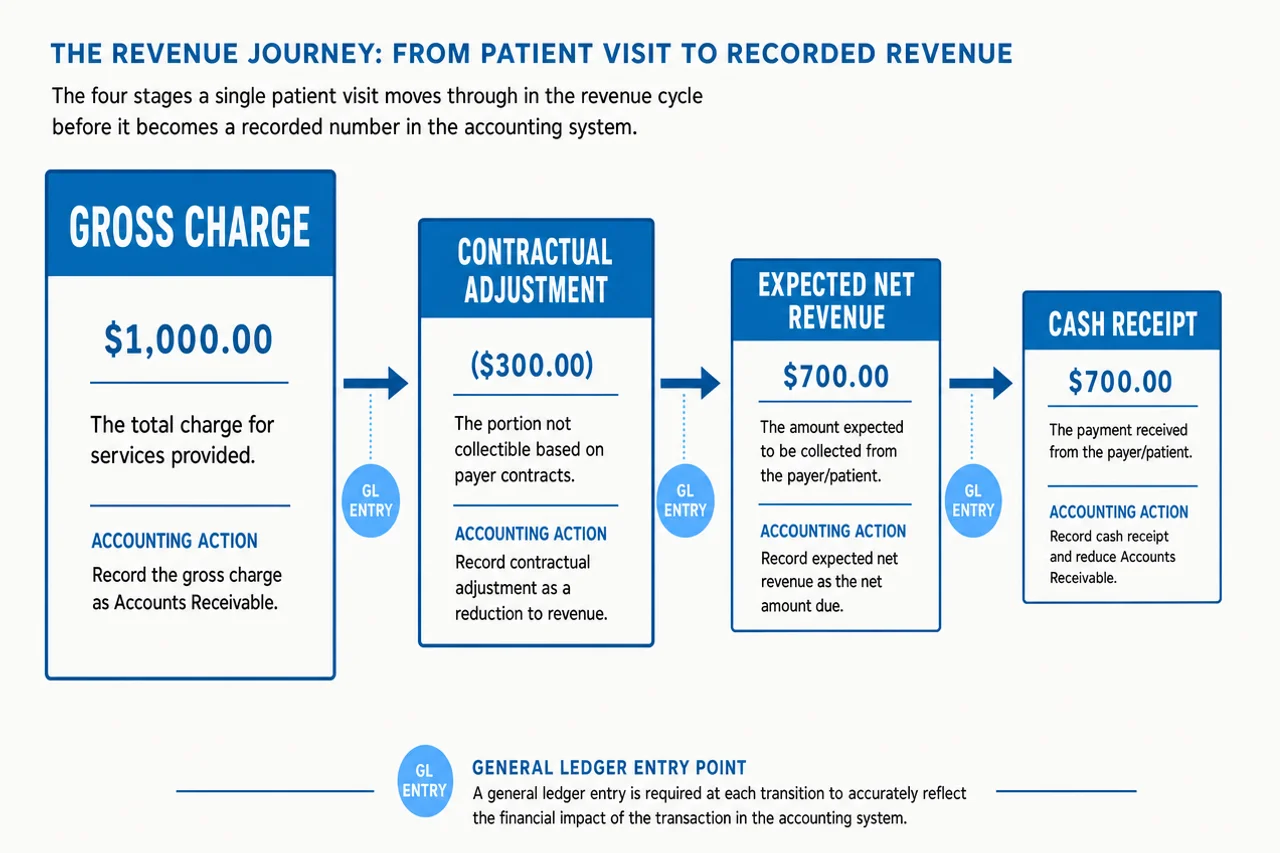
Understanding what your accounting function is supposed to record starts with understanding the journey a single patient visit takes through the revenue cycle. From an accounting perspective, that journey has four stages:
1. The gross charge, the amount billed to the payer for services rendered. This is the starting point for the revenue cycle, but it is not necessarily the amount recognized as revenue in the financial statements. Contractual terms and the practice’s accounting method determine the appropriate treatment.
2. The contractual adjustment, the reduction between what was billed and what the payer has agreed to pay under the contract. If you bill $500 and the payer’s contracted rate is $320, the $180 difference is a contractual adjustment.
3. The expected net revenue, what remains after the contractual adjustment. This is the amount the practice genuinely expects to collect from that payer for that service.
4. The cash receipt, the payment that arrives, sometimes weeks or months later, which may differ slightly from the expected net due to claim errors, secondary payers, or patient balances.
Your accounting function’s job is to appropriately capture and reconcile the relevant activity from each stage in the general ledger and supporting records. When any of these entries is missing, late, or recorded incorrectly, the financial statements stop reflecting what is actually happening in the practice.

What Revenue Cycle Accounting Entries Commonly Throw Off Practice Financials?
Three common recording issues can distort healthcare practice financials. Each can have a meaningful impact when not handled consistently.
Gross Charge Recognition Without Adjustment
Some practices record the full gross charge as revenue when services are delivered, without simultaneously recording the contractual reduction. This overstates revenue immediately, sometimes significantly. A practice seeing 200 patients a week with an average discount rate of 40% can overstate monthly revenue by hundreds of thousands of dollars this way. The books look strong, right up until collections do not match expectations and nobody can explain why.
In medical practice accounting, a gross charge is not necessarily the amount ultimately recognized as revenue. Understanding contractual adjustments and applying the appropriate accounting treatment is an area where accounting teams without healthcare-specific experience can run into serious challenges.
Late or Missing Payer Adjustment Recording
Contractual adjustments generally need to be reflected in the appropriate reporting period rather than simply being recorded when payment or an explanation of benefits is received. The specific timing and treatment depend on the practice’s accounting method and reporting requirements. When practices delay payer adjustment recording until payment is received, revenue figures for the current month are inflated, and then deflated in a later month when the adjustment finally hits. This creates a roller-coaster P&L that does not reflect the actual month’s performance. It makes trend analysis unreliable and frustrates the physician-owners who are trying to assess whether the practice is growing.
Write-Off Timing and Categorization
Write-offs for uncollectable balances are a normal part of healthcare AR accounting, but when they are recorded inconsistently or lumped into the wrong period, they distort both the current month and the comparison periods that follow. A practice that batches its write-offs quarterly rather than monthly produces monthly revenue figures that cannot be compared against each other. That is a planning problem dressed up as an accounting one.
The gap between what a billing system reports and what the general ledger shows, stems from an accounting recording issue that compounds every month it goes unaddressed.
Why Accrual-Aligned Recording Generally Gives Growing Practices a More Accurate Picture
Cash basis accounting records revenue when cash is received and expenses when bills are paid. For a single-provider practice with fast collection cycles, this can work adequately. For a growing practice managing multiple payers, multiple locations, or a meaningful gap between service delivery and payment, it creates a misleading financial picture.
“You can’t run a business based on when you pay your bills and when you get paid.” That observation from our team comes up in almost every conversation we have with practices that are scaling and trying to use cash basis financials to make growth decisions. The numbers spike when large payments arrive and dip when collections lag, regardless of what the practice’s actual performance was.
Accrual-aligned recording matches revenue to the period in which services were delivered and expenses to the period in which they were incurred. For practices where the time between delivering a service and receiving payment spans weeks or months, the timing of how revenue is recorded in the books has a direct impact on whether monthly financials reflect what is actually happening in the business.
Case Study Example
A good example of what this shift looks like in practice: a small clinic was doing everything on a cash basis and not reviewing their books for months at a time. Their financials made no sense, they had no idea what their monthly EBITDA or burn rate was, and they could not make decisions like whether to bring on a new physician. After restating five months of financials on an accrual basis, it became clear that their monthly operating expenses were approximately $200,000, giving them a simple watermark: collect more than $220,000 and you are profitable. Nothing changed in their business. The records were just finally telling them the truth.
Whether accrual accounting is the right formal approach depends on the practice’s size, complexity, and reporting requirements. A fully outsourced accounting department can assess what recording method gives your specific practice the most reliable financial picture. For practices where timing differences between billing and collection are significant, accrual-aligned recording may provide a more reliable financial picture.
To see how accrual-basis accounting for healthcare practices works across multi-location settings, read our guide on the practical mechanics of making the transition.
What Your Accounting Function Should Be Producing from the Revenue Cycle Every Month
A well-run accounting team does not just post entries. At month-end, they should be producing a set of outputs that give you and your physician-owners a reliable, readable picture of what happened financially over the past 30 days.
Here is what that should include as a minimum:
• A reconciliation between relevant billing and collection activity and the general ledger, with documented explanations for any differences
• An AR aging report, showing what is still outstanding by payer, how long it has been outstanding, and what write-off or collection action is pending. This is how healthcare AR should be managed at a practice level, not just tracked in the billing system
• Adjustment and write-off totals for the period, recorded in the correct accounts and the correct month, so that revenue figures are comparable month to month
• A revenue figure that reflects what was genuinely earned, not what was deposited, meaning adjustments have been recorded, write-offs are current, and the number on the P&L represents real performance
For multi-location practices, every one of these outputs needs to be produced consistently across every entity, using the same chart of accounts and the same adjustment methodology. Otherwise, the consolidated P&L is comparing apples to oranges, and any conclusions drawn from it are unreliable.
“We deal with complex, but we’re really good at peeling the layers of the onion back and making it simple.” That is the standard a practice should hold its accounting function to. The output should be clear, on time, and defensible.
A Note on Healthcare Practices in the Nashville Market
For healthcare practices across greater Nashville, Brentwood, Franklin, and the broader Middle Tennessee region, the complexity described here is not theoretical. Multi-location physician groups, specialty practices, and healthcare organisations across Tennessee are navigating the same billing-to-accounting gap, often with accounting infrastructure that has not kept pace with their growth. The Nashville metro has seen significant healthcare expansion over the past decade, making accurate and scalable financial reporting increasingly important for growing practices facing expansion, acquisitions, or investor requirements.
For practices where the time between delivering a service and receiving payment spans weeks or months, the timing of how revenue is recorded in the books has a direct impact on whether monthly financials reflect what is actually happening in the business.

Key Takeaways
• The billing system and the accounting system serve different purposes. Reconciling them is a core accounting responsibility, not an automatic process.
• A gross charge is not necessarily the amount recognized as revenue. The accounting function should apply the appropriate treatment for contractual adjustments based on the practice’s accounting method and reporting requirements.
• The three most common recording errors in healthcare practice accounting are gross charges without adjustments, late payer adjustment recording, and inconsistent write-off timing.
• For growing practices with meaningful collection lags, accrual-aligned recording produces a more reliable monthly financial picture than cash basis.
• At month-end, your accounting function should deliver a billing reconciliation, an AR aging report, adjustment totals, and a revenue figure that reflects what was actually earned in the period.
• Multi-location practices need consistent recording treatment across every entity or consolidated financials will not be comparable.
Is Your Month-End Close Telling You the Truth?
If your billing and accounting numbers do not agree at month-end, the cost is higher than it looks. Run the numbers with our Month-End Close Cost Calculator and see what a delayed or inaccurate close is actually costing your practice.
Questions Practice Administrators Ask About Revenue Cycle Accounting
Why does my billing system show different revenue than my accounting software?
Billing systems track gross charges and collections activity, while accounting software records net revenue after payer adjustments and write-offs. Without a deliberate reconciliation process between the two, the numbers will routinely disagree. Neither is automatically wrong. They are measuring different things, and bridging that gap is a core accounting function.
What is a contractual adjustment and does it need to be recorded in the accounting system?
A contractual adjustment is the difference between what a practice bills a payer and what the payer has contractually agreed to pay. Whether and how this adjustment is recorded in the accounting system affects whether revenue is overstated on the P&L. The right treatment depends on the practice’s accounting method and reporting needs, but leaving adjustments unrecorded or recording them late will distort monthly revenue figures.
Does a medical practice need accrual accounting for the revenue cycle to work properly?
Accrual-aligned recording is generally more useful for growing practices where there is a meaningful gap between when services are delivered and when cash is collected, because it produces a more stable monthly revenue picture. Whether it is the right formal approach depends on the practice’s size, complexity, and reporting requirements. A qualified accounting team can assess which method gives your practice the most reliable financial information.
What accounting entries does a medical practice typically need for insurance claims?
At minimum, a practice needs entries for the gross charge when services are delivered, the contractual reduction to arrive at expected net revenue, and the cash receipt when payment arrives. Write-offs for uncollectable balances are recorded separately. The specific approach varies by practice and accounting method, but all four entries need to be present and consistently recorded for monthly financials to be reliable.
How does poor revenue cycle accounting affect my monthly P&L?
If adjustments are recorded late, incorrectly, or not at all, monthly revenue figures will not reflect actual performance. They will reflect billing timing, payer lag, or cash receipt patterns instead. This makes it genuinely difficult to assess whether the practice had a strong month or a weak one, and even harder to make confident decisions about staffing, expansion, or distributions.
What should my accounting function be producing from the revenue cycle each month?
At a minimum, your accounting team should reconcile the billing system’s collected revenue against the general ledger, produce an AR aging report, account for the period’s write-offs and adjustments, and close the month with a revenue figure that reflects what was genuinely earned, not just what was deposited. For multi-location practices, this should be done consistently across every entity using the same chart of accounts.
Ready to Know Whether Your Accounting Function Is Getting This Right?
If you are not sure whether your accounting function is recording your revenue cycle correctly, talk with our team about where the process may be breaking down. Book a discovery call to discuss your practice’s accounting structure and reporting needs.