

One of the key metrics that you should be tracking in medical practice accounts receivable is your ‘Days in A/R number.’ But what is it and what does it tell you about your financial health?
Your Days in AR number might be 48 days. Maybe its 72. Someone says it is high. But is it? What’s a good ‘Days in AR number?’ We’ll look at that in this article.
Days in A/R tells you how long it takes, on average, to collect payment after services are rendered, but the number is only as reliable as the accounts receivable data recorded in your accounting system.
What You’ll Learn
• What Days in A/R measures and how to calculate it for a medical practice
• Why healthy Days in A/R ranges differ by specialty, payer mix, and practice model, and why one universal benchmark can mislead you
• What a high number is actually signaling about your billing process, accounting records, and financial close
• Why the reliability of Days in A/R depends on how your AR is recorded in your accounting system
• What steps to take when a high Days in A/R points to an accounting infrastructure problem rather than a billing problem
Table of Contents
1. What Days in A/R Actually Measures (and Why the Formula Is the Easy Part)
2. Why Healthy Ranges Are Not Universal Across Practices
3. What Is a High Days in A/R Really Signaling?
4. How Your Accounting Setup Affects the Reliability of the Number
5. What to Do When Your Days in A/R Is Too High
6. Questions Practice Administrators Ask About Days in A/R
What Days in AR Actually Measures (and Why the Formula Is the Easy Part)
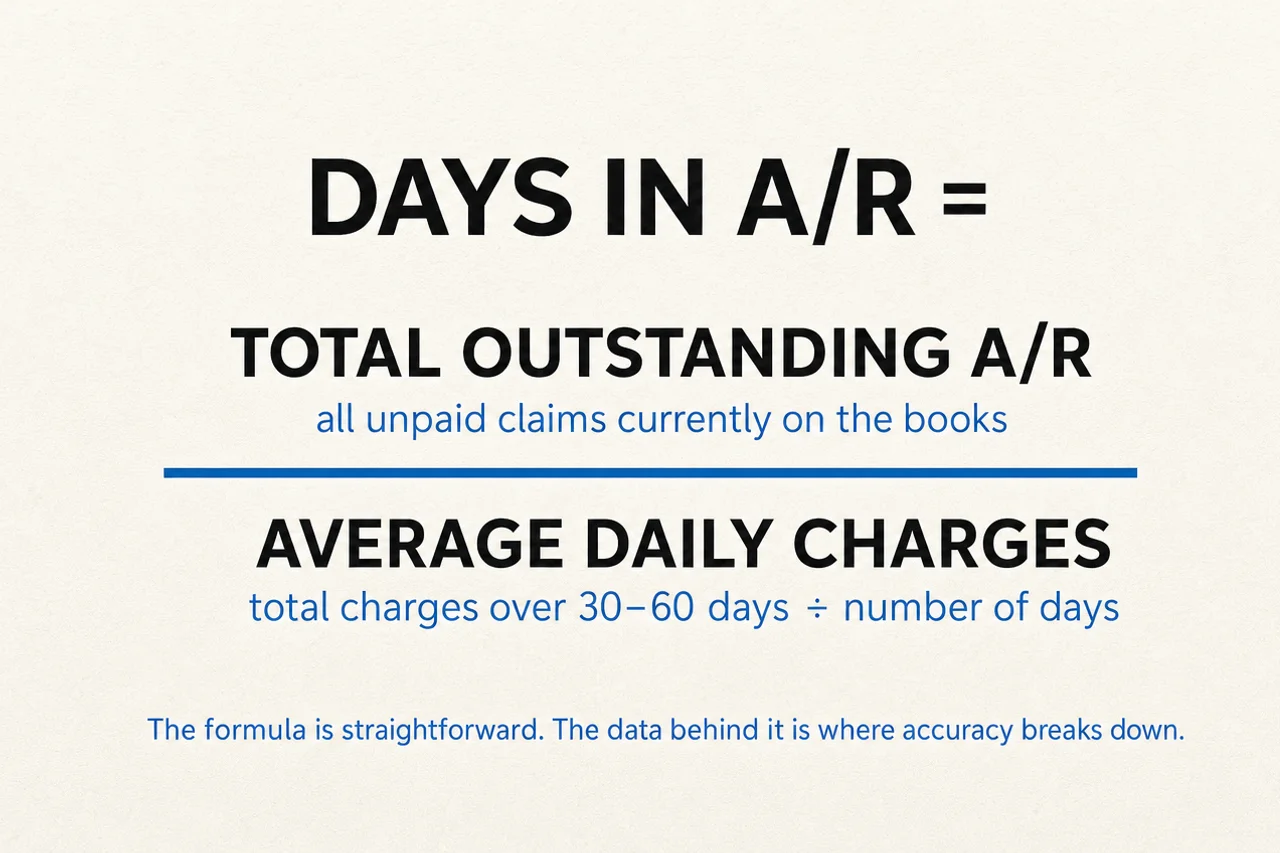
Days in AR (or, Days in Accounts Receivable), is a measure of how long it takes your practice to collect payment after services are delivered. The formula is straightforward:
Days in AR = Total Outstanding AR divided by Average Daily Charges
Average daily charges are typically calculated by taking your total charges over a 30, 60, or 90-day period and dividing by the number of days in that period. So if your practice has $300,000 in outstanding receivables and generates $6,000 in charges per day on average, your Days in A/R is 50 days.
Running the math isn’t what typically trips up medical practices. Instead, the challenge is in determining the accuracy of the underlying AR data used in that formula.
If your accounts receivables are not being properly recorded in your accounting system, the number you are calculating is not a clean metric. It is a partially informed estimate built on incomplete data. If you’re managing accounts receivable in a healthcare practice across multiple payers and locations, that gap between what is billed and what is reflected in accounting records is where the real error in the calculation creeps in.ements stop reflecting what is actually happening in the practice.
Why Healthy Ranges Are Not Universal Across Practices
So what is a healthy Days in AR figure? This is where a lot of benchmarking conversations go wrong. Someone quotes a figure, say, “healthy practices keep Days in A/R under 40”, and suddenly every administrator in the room is measuring their practice against a number that may have no relevance to how their practice actually operates.
Healthy Days in A/R ranges vary by specialty, payer mix, and service model, which means comparing your number against a generic benchmark without accounting for your practice’s specific profile may lead you to the wrong conclusion.
Here is why the range varies so significantly:
• Payer mix: A practice with a high proportion of commercial insurance payers will typically see faster adjudication than one dealing primarily with government payers, which can have longer processing timelines by design.
• Specialty type: A high-volume primary care clinic billing for routine visits will have a structurally different AR profile than a surgery center billing for high-dollar, lower-volume procedures where claims scrutiny is higher.
• Self-pay proportion: A practice with significant self-pay volume, common in aesthetics, some specialty care, or underinsured patient populations, will carry a different collection dynamic than one with near-full insurance coverage.
• Service and billing model: Practices that bundle services, charge facility fees separately, or work across multiple service lines face more complexity in adjudication timelines.
The goal is not to dismiss benchmarks entirely. Rather, it is crucial to evaluate your practice against peers sharing a truly comparable profile, instead of relying on a broad industry statistic derived from a completely different operating structure.
For multi-specialty groups or practices across outsourced healthcare accounting arrangements, this nuance matters even more because the mix of payers and specialties within one entity can create a blended Days in A/R figure that is difficult to interpret without breaking it down by location or provider.
What Is a High Number of Days in AR Really Signaling?
Once you know what a healthy Days in AR number is for your practice, what does it mean when that number starts going up?
Billing Process Gaps
The most obvious cause is delays in the billing cycle itself: claims not submitted promptly after service, denials not being followed up, or payer-specific issues not being caught in time. A billing department without clear workflows for aging follow-up can see those gaps reflected in the AR number.
Payer Adjudication Delays
Some of what looks like a collections problem is actually a payer timing problem. Certain insurers have consistently longer adjudication cycles, and if a practice’s payer mix has shifted toward those payers, Days in A/R will rise without any change in billing efficiency. The metric reflects the mix, not just the process.
Accounting Records That Do Not Reflect What Was Billed
This one gets overlooked, and it is often the most significant. If your accounting system is not capturing accrued AR correctly, because the practice runs on cash-basis accounting, or because the billing platform and the accounting system are not reconciled, then the AR figure driving your Days in A/R calculation is not accurate. You are measuring a number built on incomplete information.
Close Process Delays
A practice closing its books in the last week of the following month is working with financial information that is 30 to 45 days stale. Without the support of an accounting team that knows healthcare well, most practice owners often receive bad information, and receive it late – that’s something we commonly see. A slow close means AR aging is not being reviewed while it can still be acted on. By the time someone sees the number, the best collection window has already passed.
For multi-location practices, a single consolidated Days in A/R figure can mask significant variation across sites; per-location reporting is an important way to identify where collection delays are concentrated.

How Your Accounting Setup Affects the Reliability of the Number
This is the section most billing-focused discussions miss entirely, and it is where an accounting firm’s perspective becomes important.
Days in AR is only a meaningful metric if the AR it is measuring is properly recorded. When the accounting setup is not structured to capture accrued receivables correctly, the figure you are tracking is less reliable than it appears.
Here is what this looks like in practice:
Cash-basis accounting: When a practice records revenue only when cash is received, AR is often not fully reflected in the accounting records. The billing system may show $400,000 in outstanding claims, but if only collected amounts are being posted to accounting, the books do not reflect what is owed. The Days in AR calculation is working from different data depending on which system you pull the AR figure from. Accrual-based reporting for healthcare practices creates a more complete financial picture, especially where timing differences between service delivery and collection are significant.
Billing-to-accounting disconnect: In many practices, the billing platform and the accounting system are separate, with no automated reconciliation between them. Payer adjustments, write-offs, and contractual allowances get recorded in billing but may not make it into accounting cleanly. Month-end AR balances in accounting rarely match what billing shows, and the reconciliation is done manually, if it is done at all.
What proper accounting visibility looks like:
• AR is recorded at the time of service, adjusted for contractual allowances, and tracked through to collection
• Month-end close includes a reconciliation between billing system AR and accounting system AR
• Payer adjustments and write-offs are posted to accounting in the same period they are adjudicated
• Per-location AR is broken out, not lumped into a single consolidated figure that obscures which sites are collecting efficiently
When a practice moves to an outsourced accounting department model with proper accrual-based records, administrators often find that their Days in AR figure either changes meaningfully or becomes easier to explain, because they are finally working from complete data.

What to Do When Your Days in AR Is Too High
If your Days in AR is trending in the wrong direction, or you cannot tell whether the number is reliable, here is where to start.
Step 1: Confirm What AR Figure You Are Using
Pull the AR balance from your billing system and from your accounting system. If they do not reconcile, the problem is in the accounting layer before it is a billing problem. Find out which system is more complete and why the two figures differ.
Step 2: Break It Down by Payer and by Location
A blended Days in AR figure across a multi-location group hides more than it reveals. Ask your billing team or administrator to produce an aging report segmented by payer and by location. This tells you whether the issue is concentrated in one payer relationship, one site, or is spread across the practice.
Step 3: Review Your Aging Buckets
Look at what proportion of your outstanding AR sits in the 90-plus-day aging bucket. AR that has been sitting for more than 90 days without resolution is either being disputed, ignored, or has slipped through follow-up. A rising percentage in that bucket is a more telling signal than the overall Days in AR figure alone.
Step 4: Assess Your Month-End Close Timeline
If your close is finishing in the last week of the following month, your AR review is happening too late to act on. A well-run practice should be closing books and reviewing AR aging early in the following month, based on an established close timeline. If that is not happening, the accounting infrastructure, not just the billing process, needs attention.
Step 5: Ask Whether Your Accounting Records Reflect Accrued AR
This is the question most administrators do not know to ask. If your practice is on a cash basis, or if AR adjustments from billing are not making it into accounting, you are managing from a partial picture.
Questions Practice Administrators Ask About Days in A/R
What does Days in A/R mean for a medical practice?
Days in A/R measures how long it takes a practice to collect payment after services are delivered. It is calculated by dividing total outstanding accounts receivable by average daily charges, giving a picture of how efficiently the practice is converting billed services into cash. It is most useful as a trending metric: whether the number is improving or deteriorating over time matters more than any single snapshot.
What are good Days in A/R for a medical practice?
There is no single universal answer. Healthy ranges differ based on specialty, payer mix, the proportion of self-pay versus insured patients, and the practice’s service and billing model. A figure that is appropriate for a high-volume primary care practice may signal a problem for a surgical center with a different payer profile. The right benchmark is your own historical trend and a comparison against practices with a genuinely similar structure.
Why is my medical practice cash flow slow even though revenue looks healthy?
A gap between revenue and cash position often points to AR that is accumulating without being collected efficiently. Contributing factors include payer adjudication delays, billing follow-up gaps, and AR that is not being properly reflected in the accounting records. The last factor means the problem may be as much an accounting issue as a billing one: if your accounting system is not capturing accrued receivables correctly, the revenue line looks strong while cash tells a different story.
Does a cash-basis accounting setup affect Days in A/R accuracy?
It can. When a practice operates on a cash basis, accounts receivable may not be fully captured in the accounting records, which means the data feeding into Days in A/R calculations may be less complete or reliable. Accrual-based reporting can provide better visibility where timing differences between service delivery, billing, and collection are significant.
How do I know if my Days in A/R problem is a billing issue or an accounting issue?
If your billing system is tracking AR but that data does not reconcile with your accounting records, the problem is in the accounting layer. Signs include month-end AR balances that do not match billing reports, payer adjustments that are not being recorded correctly, and financial statements that cannot be produced until weeks after month-end. A billing problem shows up in your denial rates and follow-up activity. An accounting problem shows up in your ability to produce reliable, timely financial information.
Key Takeaways
• Days in A/R measures how long a practice takes to collect after services are delivered, but the calculation only holds up if the AR feeding into it is accurately recorded
• There is no universal benchmark: healthy ranges depend on specialty, payer mix, and service model, comparing against the wrong reference point leads to wrong conclusions
• A high Days in A/R often signals an accounting infrastructure problem, not just a billing operations problem
• Cash-basis accounting or a billing-to-accounting disconnect can make the metric unreliable before it is even calculated
• Per-location reporting matters: a consolidated figure across a multi-location group can hide which sites are the actual source of collection delays
• A slow month-end close compounds the problem by delaying AR review until the best collection window has passed
Ready to Know What Your AR Numbers Are Actually Telling You?
If your Days in A/R is not giving you a clear picture, or if your billing data and accounting records never quite agree, the gap is usually in how your accounting is structured, not just how your billing runs.
The LBMC W Squared team works specifically with multi-location healthcare practices to build the accounting infrastructure that makes metrics like medical practice accounts receivable reliable and actionable. If you want to understand what your numbers are actually telling you, book a 30-minute call with our team and we will start there.